
In this publication, we’ll take a look at why binder jetting 3D printing could be beneficial for your business or industry.
Traditional vs. additive manufacturing
First, it is helpful to understand the difference between traditional manufacturing and 3D printing. Traditional manufacturing is typically either subtractive or casting-based. Subtractive means you start with a block of material (such as wood, ceramic, stone, or foam) and start removing material by cutting or milling until the final desired shape has been obtained. For obvious reasons, this creates a lot of waste. In casting processes such as investment casting, sand casting, injection molding, and others, a mold is required to make the final part. Creating a mold is usually a time-intensive and wasteful procedure. The mold then lasts for a limited number of production runs and will need to be discarded after use. There are also limitations in the shape of the mold as the object you are making must be retrievable from the mold. Very complex undercuts or integrated patterns might not be even possible to make.
Alternatively, additive manufacturing allows objects to be built layer by layer by depositing material. This means that a 3D printer only places material where it is required, and therefore never wastes material. Parts can be loaded in a 3D printer via a 3D model of the finished product. The most used type of 3D printing is FDM, although there are methods that allow for much more precision, speed, and overall quality, such as binder jetting.
Cost-effective
Binder jetting is the most cost-effective way to 3D print parts for several reasons. The first is scale: Binder jetting can be scaled up to industrial dimensions of several cubic meters per print. This means that through economies of scale, you can print large volumes of parts with a single machine. Even our smallest CONCR3DE Armadillo printer can print up to 100 liters per day – which is almost 50x the production rate of any FDM printer on the market. This is partly because it does not matter for the printer if it prints 1 part of 200 parts: the speed is the same and many parts can be placed in the build box simultaneously.
Binder jetting also uses low-cost base materials. Our CONCR3DE stone powders are much cheaper per kilogram than any plastic available. You can even print with many different waste stream materials, such as sawdust - often making your material costs (close to) positive if you factor in the cost of waste removal and processing. Furthermore, the printing can be done at room temperature, making it an energy-efficient process. There are no expensive lasers and lenses involved, no high temperatures in the printer: All in all the investment in the equipment and its running cost are very low, especially when you look at the output of a 3D printer.
Are you curious about the running cost of a binder jetting printer for your business? Contact us for a custom ROI calculation!
Material versatility
Besides the cost-effectiveness, a valuable binder jetting advantage is the versatility of its materials. Our open-platform Armadillo printers can print an object starting from virtually any powder. The wide range of materials makes Binder jetting a flexible technology with limitless potential across various industries such as automotive, medical, and aerospace. We are constantly undertaking R&D projects to discover new capabilities and test new printing materials, such as salt, wood, glass, and more.
Sustainability
Sustainability is another strongpoint of binder jetting technology, fundamental to the process, which will be further detailed in an upcoming article.
Design complexity
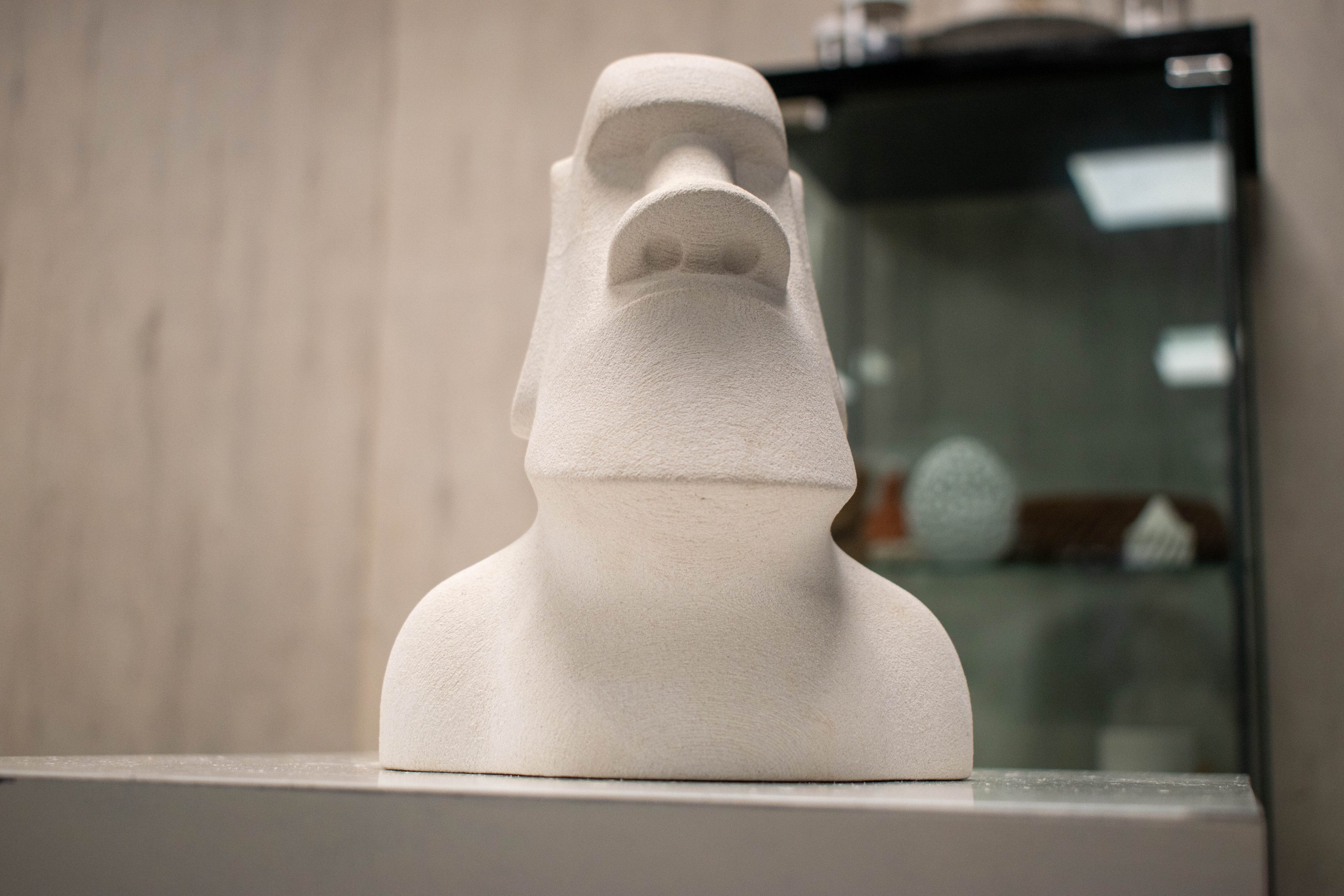
Design complexity is another key advantage. Because binder jetting works by depositing full layers of powders that are selectively bonded with a binder, each part is encapsulated in powder. This means the surrounding powders around each part function as support and therefore highly complex parts can be created. This is different compared to traditional manufacturing or even FDM binder jetting, where limitations are imposed by the tooling. The freedom of design allows the final parts to be lighter and optimized where needed, saving more material. This can be seen within this Moai head shape. The complexity of the details could only have been achieved with binder jetting.
Would you like to know more? Contact our team today!


