
We're joined today by Dustin White, Assistant Professor of Structural Design at FAU School of Architecture. His research and design practice focus on interdisciplinary collaborations, utilizing computation, sustainability, and digital fabrication.
Dustin’s work has been exhibited internationally, including at the Venice Architecture Biennale and the Marmomac Stone Expo. Prior to FAU, he served as Director of Digital Technologies and Fabrication at the New York Institute of Technology School of Architecture and Design.
For the past two and a half years, CONCR3DE has collaborated with Dustin on projects such as 'Gothic Reimagined,' which received the AIA Honor Award Object (https://www.youtube.com/watch?v=DVuLH_FUyPs), 'Technovault,' and 'Baroque Cabinet.' These projects explore the integration of AI and 3D printing in architectural design, particularly with upcycled stone waste. We'll be discussing his approach to design, the application of emerging technologies in architecture and the advantages of CONCR3DE’s binder technology in the stone industry and in design fabrication with AI.
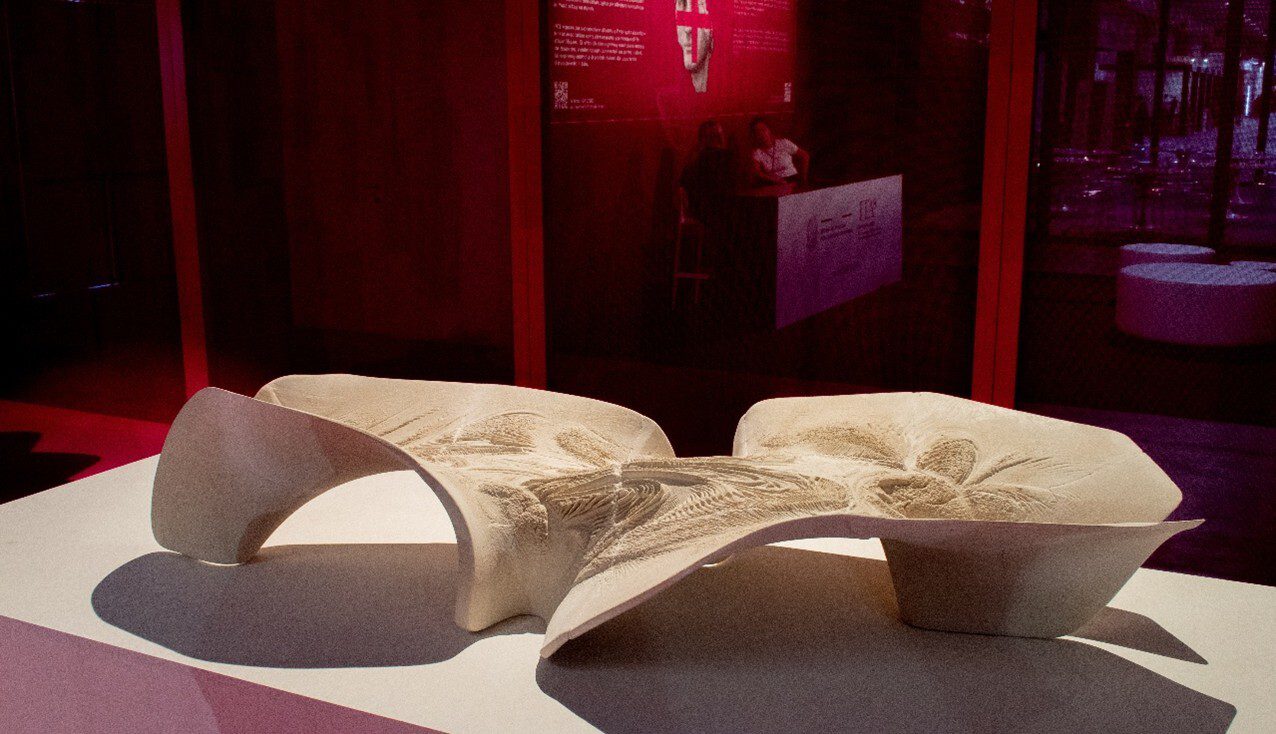
Technovault at Marmomac 2023 (Verona)
1) When did you start using AI in designing and what were your initial thoughts and feelings about the role of AI in the design process?
I jumped into AI design with Midjourney in 2022, captivated by its powerful imagery, especially the early abstract style. Initially, I was both curious about its potential for optimization and exploration and skeptical about losing the human touch. Now, I see AI as an amplifier, not a replacement, for designers. It excels at processing data, simulating materials, generating new forms, and even reviving old techniques. I believe its future lies in optimizing processes, production, and simulations, offering faster feedback. In my computational design work, AI's already a big help with structural analysis, material optimization, and sustainable design.
2) How do you use AI in your creative process? How has this tool impacted your creative process?
I use AI as a creative partner, balancing its computational power with my design vision. It helps me generate initial 3D model imagery and provides feedback through simulations. The unexpected results it can produce are fascinating, but refining the output requires strong vocabulary and historical knowledge. AI has expanded my creative possibilities, allowing me to explore more forms and reinterpret architectural history, like combining Gothic and Baroque elements in new ways, as showed in my Gothic Reimagined project. It streamlines tasks by offering fresh perspectives on history and challenging design norms. Challenges include dealing with the stylized output of early AI, and now, addressing bias in larger datasets by carefully refining prompts. Integrating AI also means adapting my entire design workflow. Initially, low resolution and translating abstract images into detailed 3D models were hurdles, requiring new software and custom code. Now, as AI evolves towards 3D, the focus is on overcoming biases in training data to get more diverse and original results.
 Gothic Reimagined in Limestone (2023)
 Gothic Reimagined with AI inspiration image
 Details of Gothic Reimagined (2025)
3) What are the key advantages of binder jetting technology that make it particularly useful for your design work?
In my research, my work is focused on topics of Sustainability & Biocompatibility, Functional Gradation, and Bespoke & Site Specific Design. Binder jetting allows us to utilize waste streams and work with healthy materials. I was drawn to CONCR3DE because its technology enables to recycle stone waste. I am disappointed because there is not enough binder-jetting in the industry. It allows to have a very high resolution and to produce things that can never be created by robotic arms or by hand. This is what is really exciting about the technology. Especially with limestone materials you can create sculptures that evoke historical forms while showcasing digital pixelation, creating a unique aesthetic. Binder jetting allows you to overcome environmental challenges and promote responsible material management in the construction and architecture industries, with the intent to minimize the environmental impact of construction activities and promote bio-based and healthy material practices and sustainability of our built environment. The technology also allowed me, at least in the Gothic Reimagined, the ability to pursue a novel architectural aesthetic through a fluid reorganization of material and ornamentation, evoking the appearance of elements retrieved from historical construction but reinvented into a new blended configuration not yet seen or experienced before.
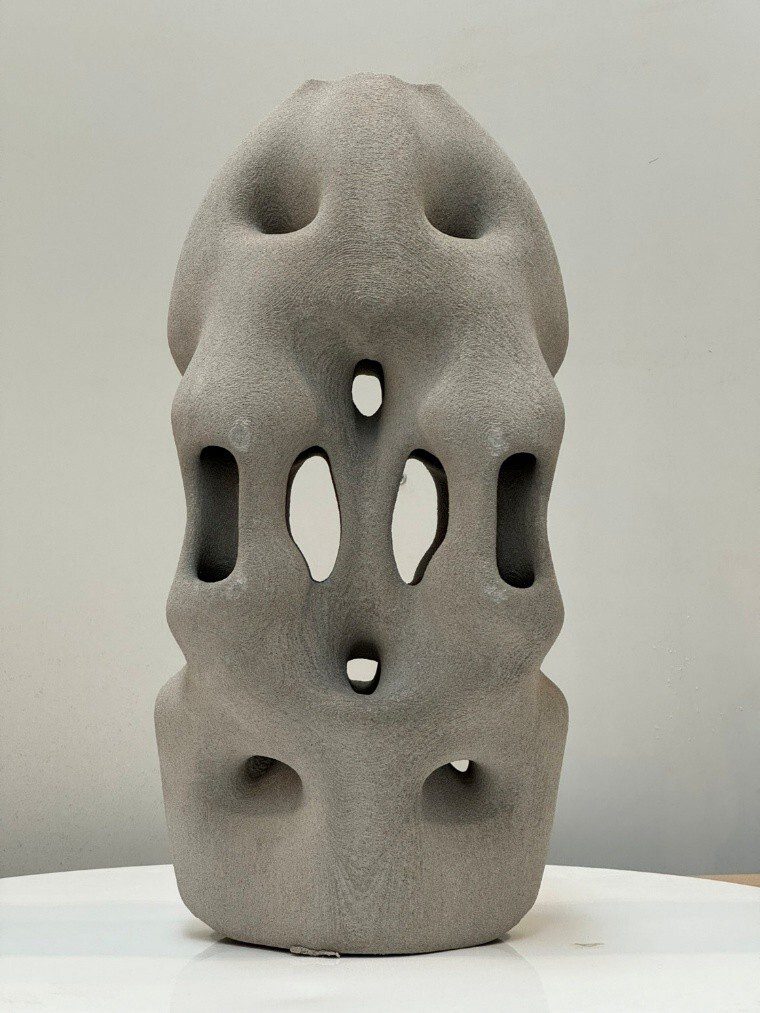
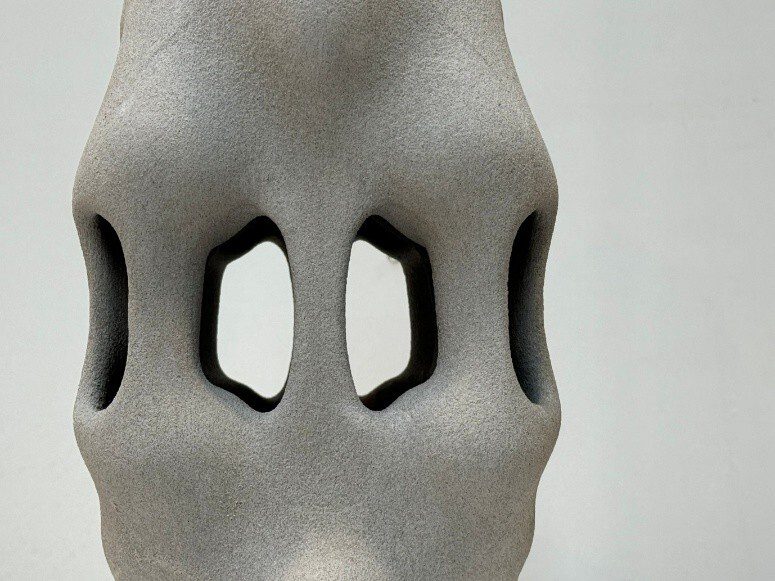
Lamp in Granite
4) What made you choose CONCR3DE as a partner for your projects?
Having worked in the stone industry for a long time, I could see the huge amount of waste that was produced. This is why, I was immediately drawn to CONCR3DE's innovative approach to upcycling stone waste. Discovering CONCR3DE's commitment to addressing this very issue by finding valuable applications for stone byproducts was incredibly exciting. This shared vision for a more sustainable future, combined with CONCR3DE's technical expertise and open-mindedness towards experimentation, made them a natural and compelling partner for my projects.
5) What is it about the CONCR3DE stone materials offers that you find so appealing or suitable for your designs?
What I find particularly appealing and suitable about CONCR3DE's stone materials for my designs goes beyond just their aesthetic qualities. The core attraction lies in their commitment to producing materials that are both healthy and demonstrably sustainable. In today's design and construction landscape, I believe we have a critical responsibility to re-evaluate the materials we choose to build with. It's concerning to realize that many of the materials we interact with daily contain toxic substances or release harmful chemicals. Embracing materials that are more bio-based and healthier to work with is not just a preference; it's a necessity that we, as younger designers, must actively pursue. This shift towards healthier materials isn't something that previous generations have necessarily prioritized or passed down to us, making it our imperative to innovate and create these alternatives. I strongly believe that CONCR3DE shares this fundamental understanding and that it forms a core part of their agenda. Beyond the health and sustainability aspects, the technology they employ allows for an astonishingly high level of quality and surface fidelity that I haven't encountered with other fabrication processes. This precision opens up a lot of possibilities in terms of intricate detailing. It's about creating designs that are not only visually compelling but also contribute to a healthier and more sustainable built environment, and CONCR3DE's application in the architecture and design industry perfectly align with this vision.
6) What AI-powered design tools or platforms are you most interested in or have experience with?
For image generation, I primarily use Midjourney and Stable Diffusion. For video, it's Runway ML, and for converting images to 3D models, especially for smaller objects and furniture, Tripo 3D works really well. At Florida University, we're developing a unique computational methodology where we create our own datasets from our 3D modeling tools. This allows us to use Google SOM; for instance, by inputting five parameters for a lobby, the system generates thousands of variations that we can then bring back into our modeling software. This gives us a controlled way to generate series of spaces based on our specific parameters, which is a unique aspect of our work there.
7) What are the most exciting opportunities and the problems you see for AI in the future of design?
I'm really excited about AI's potential to boost creativity, sustainability, and efficiency in design. It could revolutionize new material development and provide real-time feedback on performance and environmental impact during design, which would be huge. However, I'm also concerned about AI lacking human intuition and potentially leading to overly complex designs that lack depth and understanding of human experience. Over-reliance on AI could also cause designers to lose fundamental skills like hand sketching and material knowledge. We've seen this a bit in digital fabrication, where the human touch can sometimes be lost. I'm actively trying to integrate hand processes into digital fabrication in my own work to maintain that essential human element.
Would you like to know more? Contact our team today!


