
CONCR3DE is excited to showcase our new Washout materials, a solution for complex tooling of composites. This new solution leverages binder jetting technology to 3D- print water- soluble mandrels for hollow composite parts with enclosed geometries and intricate undercuts. This innovative process offers a cost-effective and time-efficient solution not only for prototyping and small-scale production but also for industrial-scale manufacturing, and will be launched at Formnext 2024, the central hub for Additive Manufacturing, in Frankfurt this November. Please read along for a technical sneak preview of material, which is already used by some of our advanced customers in the aerospace and racing industry.
 Mandrel in washout.
Applications across industries
Typical products manufactured by using this technology are ducts, air intakes, manifolds, mechanical parts made of composites and hollow injection molded plastic parts. The H2O soluble material is a sustainable material that finds applications in the aerospace, automotive and motorsport industries, but also in the production of racing bicycles as well as hydraulic and pneumatic components. The material can be easily washed off after molding, allowing the manufacturing of complex geometries.
CONCR3DE's Washout technology finds applications in various sectors:
Formula 1 and Motorsport: The new rules for the 2026 Formula 1 championship will bring several significant changes. There will be a greater emphasis on aerodynamics, with cars designed to be lighter, more agile and faster, with the overall weight of the car being reduced and the dimensions changed, to improve the ability to race. Every part of the body of a Formula 1 will be redesigned to be lighter and improve aerodynamics. In other words, there will be more and more hollow parts made of carbon fiber-reinforced plastic (CFRP). It is expected that modifications to the body parts will be required at each race to better adapt the behavior of the vehicle to the different characteristics of the circuits. That’s a good scenario for Additive Manufacturing and very good for binder jetting 3D printing. In the past, many innovations designed in Formula 1 and Motorsport have been inherited by road cars and motorcycles.
 Hollow parts made of composites for Formula 1 and motorsport. Source: AMG Mercedes.
Aerospace: Aircraft components, including air conditioning ducts, can be produced with intricate geometries and reduced weight using this technology.
 Air conditioning duct for aircraft cabin. Source: Hutchinson.
Manufacturing: Hollow injection molded reinforced or pure plastic parts can be created with greater precision and efficiency.
 Injection molded plastic hollow part. Source: Plastique Gagnon.
The advantages of 3D printing Washout materials
Lower CTE: Washout materials offer significant advantages due to their ceramic composition, which typically constitutes 80-90% of the material. This ceramic content grants them a lower coefficient of thermal expansion (CTE) compared to materials made entirely of polymers.
Reduced lead time: By eliminating the traditional process of constructing a mold for the core, or milling it from solid material, this technology significantly streamlines the production timeline. This reduction in lead time translates to faster product development and customization, making it an appealing choice for industries that prioritize rapid turnaround and flexibility in design.
The Efficiency of binder jetting
Compared to fused deposition modeling (FDM), binder jetting technology offers significant advantages in terms of speed and cost. For example, a 100 mm cube can be printed in approximately 30 minutes using a Our Armadillo XL, while an FDM printer would require around 14 hours. This efficiency is amplified when printing multiple parts simultaneously. Binder jetting technology can print all layers of all parts in a single operation, resulting in a dramatic reduction in printing time. Up to 6 cubes can be printed in three hours with Armadillo XL, and up to 200 cubes can be manufactured in the same time with CONCR3DE Elephant. This level of efficiency demonstrates that our binder jetting technology can compete with traditional industrial manufacturing methods. The lower cost associated with binder jetting 3D printing is primarily due to its ability to produce complex parts with minimal support structures and reduced material waste. Additionally, the binder jetting process often requires less post-processing than FDM, further contributing to cost savings.
The Washout process
Our water soluble cores, 3D printed using binder jetting technology, are used to create complex hollow plastic and composite parts. This method eliminates the need for complex and costly cores, making it ideal for producing parts with intricate internal features. The process involves:
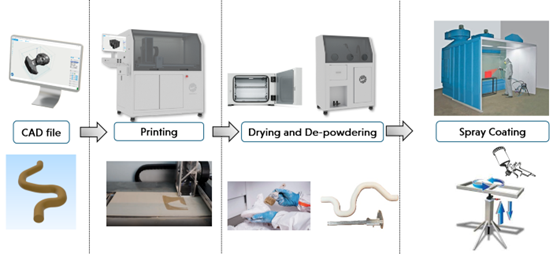
- PRINTING: Samples are sliced in our NOAH Production software with the desired layer thickness. The print head releases the binder droplets exactly and only in the positions corresponding to the section of the sliced part.
- PRE-CURING-DRYING: The mineral binder is a commercialized type of inorganic binder that requires drying to ensure a strong joint between bonded filler particles for further post-processing.
- DEPOWDERING: De-powdering is the stage in the binder jetting process where the loose powder is removed. An electro-pneumatic system automatically pulls up the bottom plate of the Job Box, and buried samples are carefully extracted using a brush and air gun.
- COATING: A water- soluble spray-on coating or adhesive tape wrap (or any type of coating that is needed) is used to prepare the parts for finishing for final application and adjust surface roughness depending on application.
CONCR3DE's Washout technology represents a significant advancement in the field of 3D printing, offering a versatile and efficient solution for producing hollow composite parts across various industries. With its potential to reduce costs, improve lead times, and enable the creation of complex geometries, this technology is poised to revolutionize the manufacturing landscape.
Be among the first to benefit from this innovative solution!
Would you like to know more? Contact our team today!


