
In the ever-evolving landscape of 3D printing, the ability to create high-performance ceramic parts with intricate designs is crucial. A key advancement in this field lies in the development and application of particle-filled binders, a technology that our partner and supplier, WZR, has mastered.
Binder jetting offers significant advantages in ceramic part production, particularly in overcoming the dimensional and cost constraints of other technologies. However, binder jetting alone may not always achieve the requisite strength and density for advanced industrial applications. Particle-filled binders address this limitation, enabling the production of strong, dense parts.
WZR's expertise centers around water-based binders, a fundamental choice that ensures environmental friendliness and compatibility with various ceramic materials. These binders are not simply water; they are formulated with additives to achieve the precise jetting properties required for 3D printing. Some binders consist solely of water and these additives, while others, designed for advanced applications, incorporate ultra-fine ceramic particles.
"The maximum particle size we work with is below 1 micron," explains Dieter Nikolay, Managing Partner of WZR. "This level of fineness is crucial. By jetting these suspensions, we ensure the particles are homogeneously distributed within the powder bed, preventing the agglomeration that occurs when simply mixing them into the powder."
This precise distribution is critical for the subsequent sintering process, the final step in ceramic production. By starting with a uniform particle dispersion, the ceramic material sinters more effectively, leading to denser and stronger final parts.
Enhanced Ceramic Properties and Applications
The versatility of particle-filled binders extends to a wide range of ceramic materials. For alumina ceramics, incorporating alumina particles into the binder significantly increases the density and strength of the green parts. This enhanced performance makes these binders ideal for applications demanding high structural integrity.
"These binders are more challenging and expensive to use," Dieter acknowledges, "but they are essential for applications where low porosity and high strength are paramount. They aren't intended for cheap, porous parts."
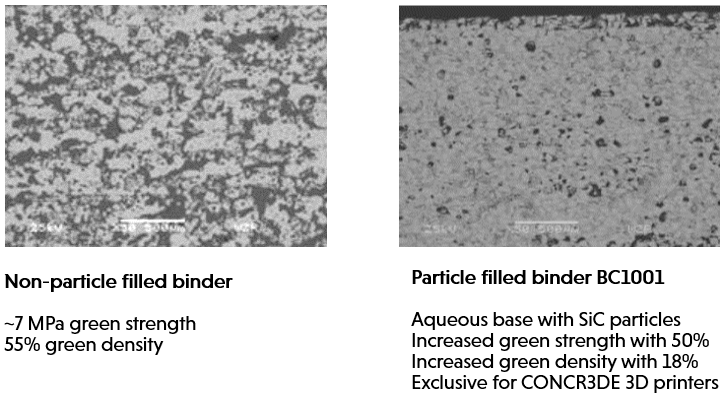
Silicon Carbide (SiC) is another material benefiting significantly from particle-filled binders. By incorporating carbon into the binder, or even the powder bed, the traditional, time-consuming process of dipping green parts in a carbon suspension and pyrolyzing them can be streamlined or eliminated. This is particularly advantageous for producing SiSiC (silicon-infiltrated silicon carbide) materials, where the porosity of binder-jetted parts is filled with molten silicon. As shown in the images below, green parts produced with particle-filled binder exhibit noticeably increased strength and density compared to those without.
"Binder jetting is a good match for silicon carbide," says Dieter. "It allows us to produce complex SiC parts, like wafer chucks, which are difficult or impossible to manufacture using traditional methods or other 3D printing techniques like VPP (Vat Photo Polymerization)." While VPP offer high detail, strength, and density, they are limited by part size, wall thickness, and cost. Binder jetting, especially when coupled with particle-filled binders, provides a faster and more cost-effective solution for producing larger parts with thicker walls. Furthermore, materials like silicon carbide, due to their optical properties, are not compatible with light-curing resin-based methods like VPP.
Practical Challenges
Working with particle-filled binders presents unique challenges. The suspensions tend to sediment over time, potentially clogging the printer. To overcome this, CONCR3DE 3D printers are equipped with a recirculation system and printheads designed to handle these specialized binders. "People often worry about nozzle damage from particles," Dieter explains. "But with well-developed binders, this is not a problem. We've seen printhead lifespans comparable to those using particle-free binders. There is no clogging and no damage when working with a properly formulated binder."
A Collaborative Approach to Material Development
WZR's business model revolves around collaborative material development. They work closely with customers to create tailored binder and powder solutions or they develop their own materials that are ready to go. This allows customers to either produce their own materials or purchase them.
Thanks to the collaboration with WZR, for ceramics as for all the other material, CONCR3DE is able to provide a complete solution, not just a printer. As Dieter points out “this is a strong point for CONCR3DE, as customers don't have to spend time and resources on material development.” CONCR3DE's collaboration with WZR stems from WZR's long-standing expertise in formulating binders for a comprehensive range of ceramic materials. This partnership is particularly advantageous because it combines WZR's specialized binder development with our cutting-edge binder jetting technology. CONCR3DE process enables the fabrication of parts with highly complex geometries, opening up new possibilities for applications in demanding fields such as aerospace and high-performance industrial components, where intricate shapes and material properties are critical.

"It's a challenging field," Dieter concludes, "but the benefits are undeniable. For high-performance ceramic applications, particle-filled binders are essential. We are excited to continue working with CONCR3DE and other partners to drive innovation in this space."
At CONCR3DE, we offer an all-inclusive solution, providing both the printer and the specialized WZR materials, guaranteeing high resolution and results. If you are interested in WZR materials and CONCR3DE binder jetting technology, please contact us.
Would you like to know more? Contact our team today!


