Skip to page content CONCR3DE logo
  • Industries
    Research & Development Automotive Aerospace & Defense Energy Construction & Restoration Design & Consumer Products Semiconductor
  • Materials
    Silicon Carbide Washout Stone Wood Other materials Sample Kit
  • Printers
    Armadillo Elephant Custom
  • Technology
  • Publications
  • About
  • Customer portal
Request a quote
Request a quote
  1. Home
  2. Publications
  3. Additive vs. subtractive manufacturing

Additive vs. subtractive manufacturing

Learn · 4 min read

Additive vs. subtractive manufacturing

In the world of 3D printing, we often talk about concepts such as additive and subtractive manufacturing. While both methods are used to create finished products, they are radically different in their processes. But what are they exactly? And how do they relate to binder jetting?

Subtractive manufacturing

Subtractive manufacturing involves removing material from a larger block material to create the final product. This is typically done using a CNC machine that uses cutting tools to remove material until the desired shape is achieved. During this process, scrap material is created from shaping the material. Even though traditional manufacturing methods often require an expensive mold with a limited lifetime, these methods might be more cost-effective for larger production runs.

Additive manufacturing

Additive manufacturing, also known as 3D printing, is the process of building an object starting from a digital model and building the finished product layer by layer through different methods. They can include extrusion-based technologies, such as FDM, used for plastics, or techniques, such as EBM or DMLS, used for metals. In the case of binder jetting, a finished product is built by depositing a binder agent on a powder bed. The powders vary from stone to metal powders and ceramics. Additive manufacturing processes are functional when high precision is required and where there are complex geometries that traditional manufacturing methods cannot produce. Furthermore, their use is ideal for small-scale production runs or prototyping since 3D printers do not require a mold, which is often expensive. It is also great for when speed is important: the time from a CAD 3D model to a physical part can be just hours instead of weeks.

Binder jetting

Within the additive manufacturing methods, binder jetting is where our expertise lies. A differentiation between this technology and the other 3D printing methods is necessary. In binder jetting, the printhead deposits binder on a printing bed one layer at a time. This method allows for the simultaneous production of multiple parts within the same build volume, which significantly increases the throughput compared to traditional additive manufacturing techniques. Binder jetting printers usually have larger printing volume when compared to other 3D printing technologies. For example, CONCR3DE supports printing up to 6 x 3 meters in size, with a maximum height of 1 meter. Furthermore, the costs associated with printing are minimal, since the powders can be recycled with hardly any waste. All of these factors make binder jetting the most scalable 3D printing technology, enabling the user to have full production runs, but without the costs associated with molds or tooling that are often required by traditional manufacturing methods.

Which method to choose?

In summary, it depends on the specific needs of each manufacturer. Small-scale production runs of complex geometries are more suited for additive manufacturing, while subtractive manufacturing provides a smoother surface finish straight out of the mold (whereas a printed part might require post-processing to achieve the same finish), and it is more indicated for large production runs. Binder jetting is an exception, as it can be integrated in considerable production cycles, while being cost-efficient at the same time.

Are you considering switching to additive manufacturing processes? We advise you to take the table below as a rough reference and make the most economically-convenient decision. If additive manufacturing could be of interest, please feel free to contact us and explore the options with CONCR3DE!
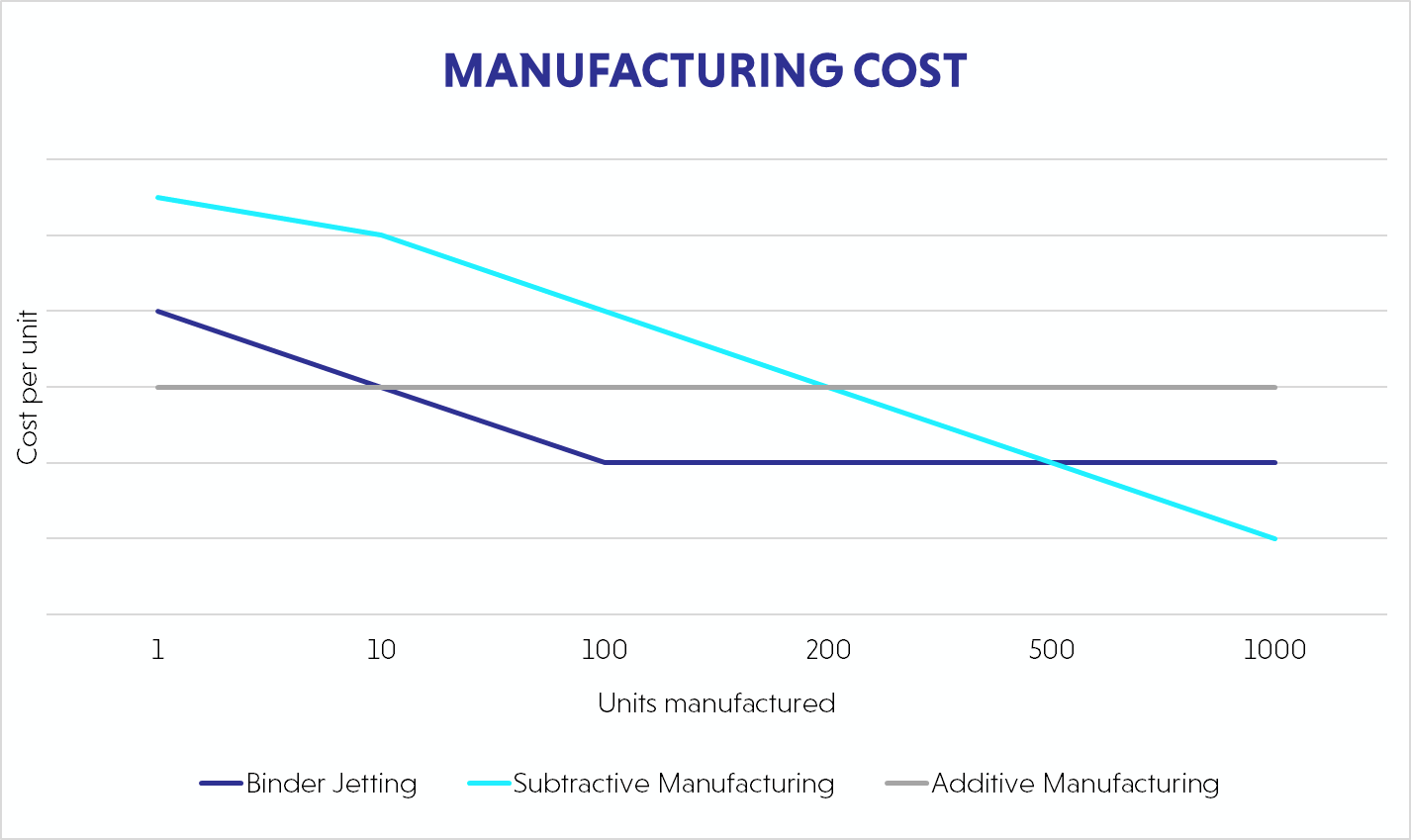
Manufacturing cost

If additive manufacturing could be of interest for your application, please feel free to contact us so we can help you explore the options.


Would you like to know more? Contact our team today!
Dustin White on AI, 3D printing, and the future of architectural design

Dustin White on AI, 3D printing, and the future of architectural design

We're joined today by Dustin White, Assistant Professor of Structural Design at FAU School of Architecture. His research and design practice focus on interdisciplinary collaborations, utilizing computation, sustainability, and digital fabrication.

Learn more →
Introducing: our new Depowdering Station

Introducing: our new Depowdering Station

In the world of 3D printing, binder jetting stands out for its ability to produce complex geometries at high speeds.

Learn more →
Depowdering your prints, how does it work?

Depowdering your prints, how does it work?

Learn the why and how of the depowdering process as integral part of any binder jetting 3D printing process.

Learn more →

This website uses cookies

We use cookies to personalise content and ads, analyse our website traffic and improve our services.

Without the necessary cookies the site can't work properly. Think of basic functions such as page navigation and access to secure areas. Craft's default cookies don't collect personal or sensitive information or IP addresses, and the information they store isn't sent to other parties.
Name: CraftSessionId
Description: Craft uses PHP sessions to keep sessions between web requests, via the PHP session cookie. Craft names this cookie "CraftSessionId" by default. It expires when the session expires.
Provider: this site
Expiry: Session
Name: *_identity
Description: When you log in to the control panel you get an authentication cookie that keeps you logged in. It only stores what is needed for a secure, authenticated session and only exists while you are logged in to Craft.
Provider: this site
Expiry: Persistent
Name: *_username
Description: If you tick "Keep me logged in" when logging in, this cookie remembers your username for the next time.
Provider: this site
Expiry: Persistent
Name: CRAFT_CSRF_TOKEN
Description: Protects us and you against Cross-Site Request Forgery attacks.
Provider: this site
Expiry: Session
These cookies help us understand how visitors use our website by collecting and reporting information anonymously.
Functional cookies are used for features from external services that aren't strictly needed for the basic functions of this website, but add extra functionality, such as protecting forms against spam (for example with Google reCAPTCHA).
Name: Google reCAPTCHA
Description: https://policies.google.com/privacy
Provider: Google
Expiry: Persistent
Showing embedded videos from external platforms such as YouTube and Vimeo. These services can set cookies or use other techniques to collect information about how the video is used. Videos only load after you give consent.
Name: vimeo
Description: https://vimeo.com/legal/privacy/cookies
Provider: Vimeo
Expiry: Persistent
Name: youtube
Description: https://policies.google.com/technologies/cookies
Provider: YouTube
Expiry: Persistent

CONCR3DE

Your 3D Powderhouse

Scheepsbouwplein 8
3089 JX Rotterdam
The Netherlands

Products

Printers

Materials

Industry & High-Tech

Company

About

Publications

Contact

Follow

Instagram

LinkedIn

© 2026 Concr3de. All rights reserved.

  • Terms & conditions
  • Cookie policy
  • Privacy policy